Mission: Mars · SpaceX published figures · August 2026
Making life multiplanetary
SpaceX published the architecture. This desk keeps the loads that architecture still has to close on the surface — ice, watts, dust, and the 2,400 tons of methane and oxygen that have to exist before anyone comes home.
The scale
A city, not a flag.
Establishing a self-sufficient city on Mars will require upwards of one million people and millions of tonnes of cargo. Several thousand Starships transfer that crew and equipment. The way you fill a window that opens only every ~26 months is to launch more than ten times a day while it is open.
People
~1 million
The published threshold for a self-sufficient city.
Cargo
Millions of tonnes
Not a flag and a habitat. An industrial base.
Ships
Several thousand
Starships transferring crew and equipment across windows.
Window cadence
>10 launches / day
To fill a ~26-month transfer window instead of wasting it.
The planet
Mars, as flown to
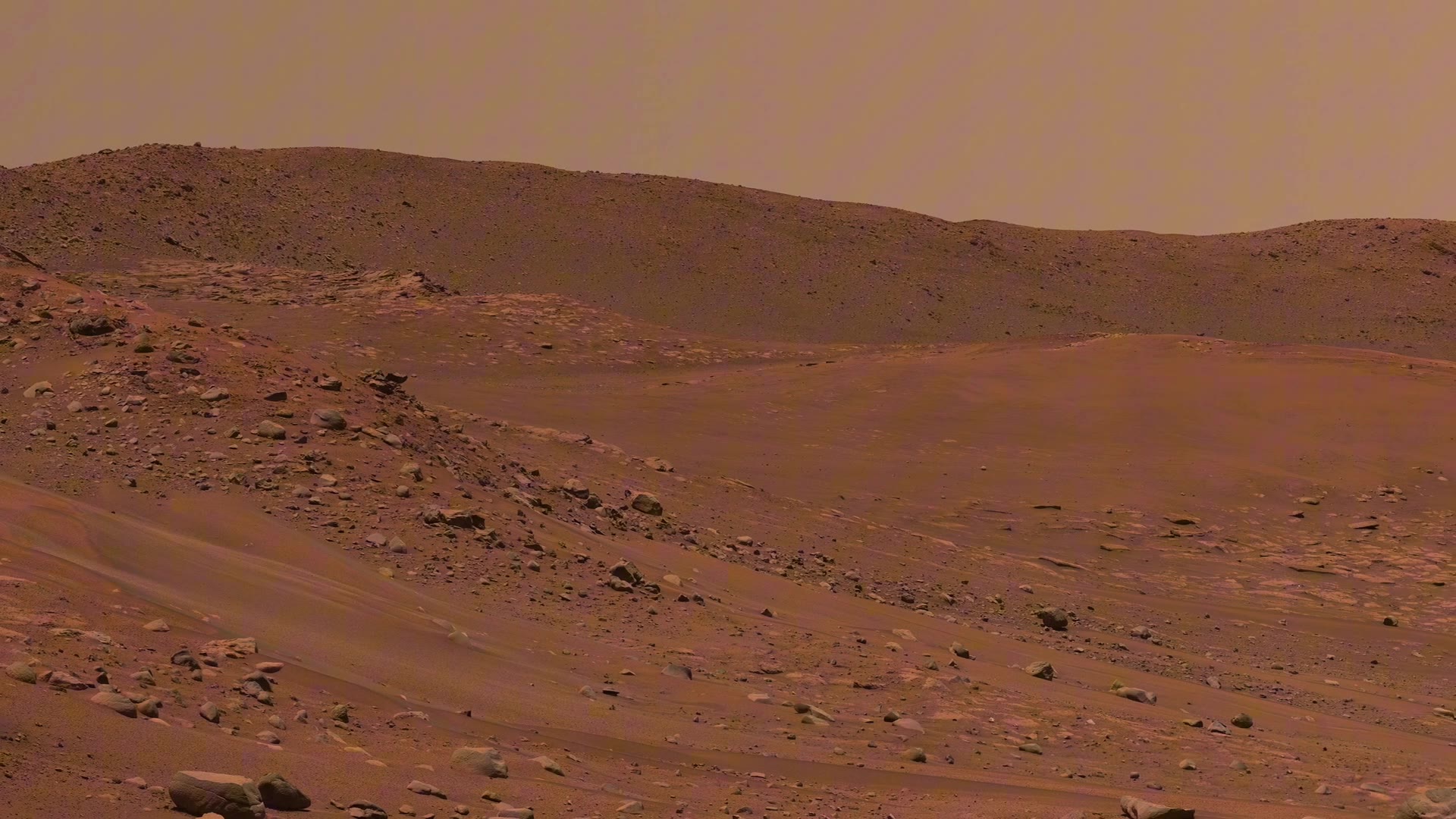
Mars is one of Earth’s closest habitable neighbors. It sits about half again as far from the Sun as Earth, so it still has decent sunlight.
It is a little cold, but it can be warmed. The atmosphere is primarily CO2 with nitrogen, argon, and trace elements — plants can grow if that air is compressed.
Gravity is about 38% of Earth’s. The sol is 24 hours 40 minutes, close enough that a crew’s clock does not have to be reinvented.
- Diameter
- 6,791 km
- 4,220 mi
- Sol
- 24 h 40 min
- close to an Earth day
- Gravity
- 38% of Earth
- heavy work, long bounds
- Mean distance
- 225 Mkm
- 140 million miles
- Age
- 4.5 Gyr
- same order as Earth
Landing
7.5 km/s
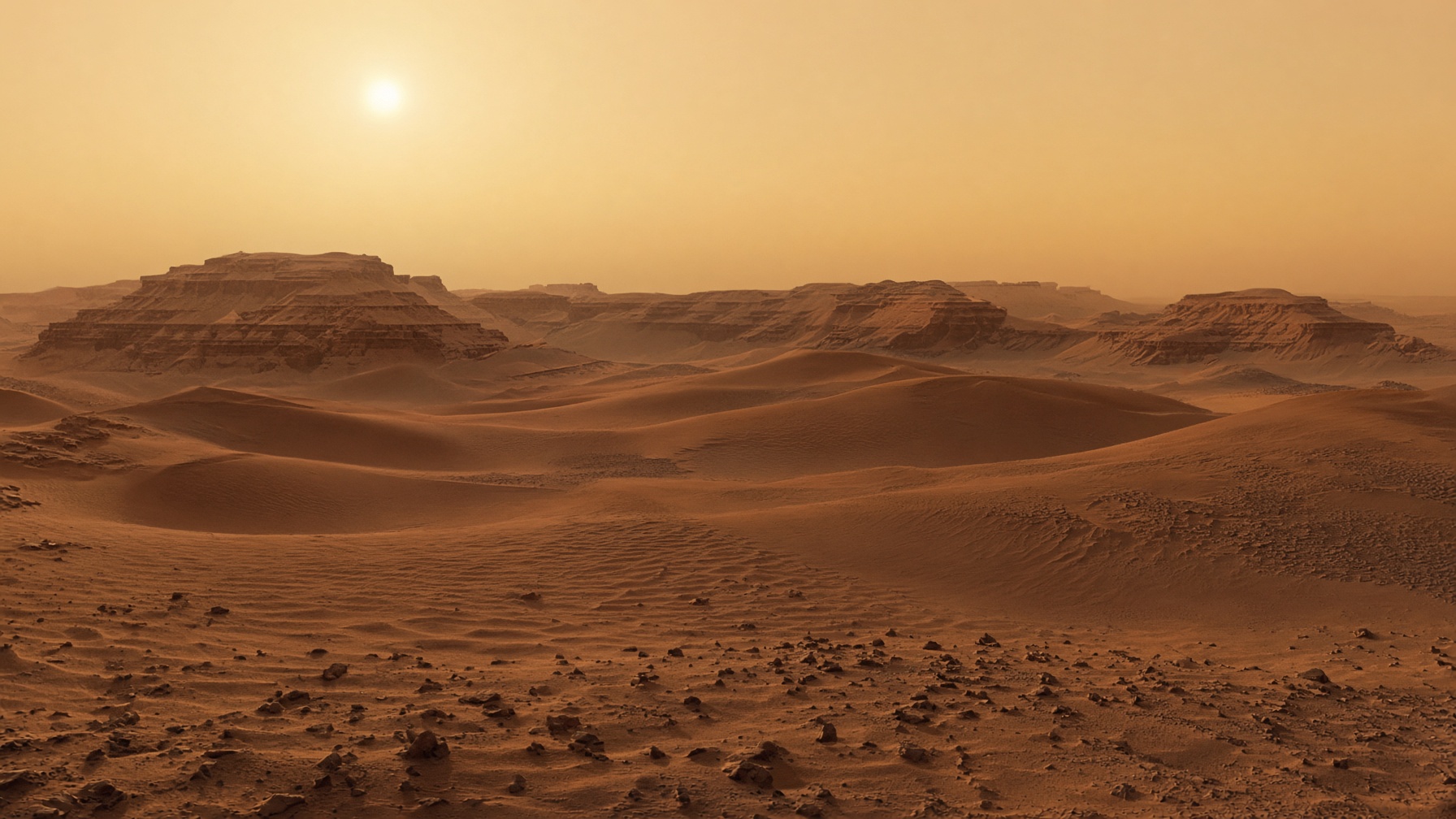
Starship enters Mars’ atmosphere at 7.5 kilometers per second and decelerates aerodynamically. Aerodynamic deceleration, then flaps, then landing burn.
Designed to withstand multiple entries. Mars entry sees higher atomic oxygen than Earth return — harsher on the shield, not milder. SpaceX has tested actual Starship heatshield materials in a simulated Mars atmosphere.
Flight 13 already returned the first intact heatshield views from an Earth entry. Mars is harsher atomic oxygen, not a dress rehearsal that gets easier.
ISRU
Designed to drink what Mars can make.
Starship was designed from the beginning to run off liquid methane and oxygen — natural resources that can be mined and refined on Mars. That is not a later upgrade. It is why the engine exists. If the plant is not producing before the crew leaves Earth, there is no return.
This desk: 1,200 metric tons of LOX/LCH4 per ship, 2,400 for a two-ship return, 3.6 MW continuous to run Sabatier, electrolysis, cryocapture, soil bake, and liquefaction. Powering Mars.
First explorers
They do not arrive to live. They arrive to make living possible.
The first human explorers to visit Mars will lay the groundwork for a permanent presence. Published mission objectives:
01
Survey local resources
Ice, minerals, landing hazards, and the ground that has to take a city. The first crews do not arrive to live. They arrive to map what the next ships will stand on.
This desk: 20–30 m global equivalent ice. Extraction, not inventory, is the unsolved load.
02
Prepare landing surfaces
Starship needs prepared ground as cadence rises. Dust, slope, and ejecta are not a one-ship problem.
This desk: the last meters of dust over equatorial ice. Pads fail if the surface is still a powder.
03
Set up power generation
Published plan: power on the surface before a city can exist. Without it there is no mining, no propellant, no habitat that lasts a night.
04
Build habitats
First explorers lay the groundwork for a permanent presence — not a stay, a start.
This desk: life support is a load, not a vibe. 100-person ECLSS is already 2.25 MW before industry.
Industries
A permanent home is a set of new industries.
Key technologies are required to establish a permanent home on Mars and to give people on Earth a way to take part. Established launch and landing sites enable global mobility on Mars and return capability to Earth.
Power generation
The city does not run on hope. Generation has to survive dust, night, and winter.
Resource mining
Water ice, metals, and atmosphere. Survey first, then extract at a rate that feeds the next window.
Propellant production
Starship was designed from the beginning to run on liquid methane and oxygen that can be mined and refined on Mars. If the plant is not running, nobody comes home.
Construction
Landing surfaces, habitats, berms, tanks, cable. A city is a build sequence, not a render.
Communication
A second world is useless if it cannot talk to the first — and to the ships still in transit.
Transportation
Established launch and landing sites enable global mobility on Mars and return capability to Earth.
Cargo
The first paid tonnes
Starship cargo flights to the Martian surface for research, development, and exploratory missions start No earlier than 2028, at $100 million per metric ton.
Payload mass, pricing, and timeframes are SpaceX sales — not this desk.
Sites · 25 Aug 2026
A second coast
Starbase, LA. A spaceport on the Louisiana Gulf Coast enabling a multiplanetary future. Newest Starship launch site currently under development, designed for high-cadence launch. Built to support thousands of Starship flights a year: propellant production, power generation, deep-water shipping, vehicle processing, and an airport. Construction starts 2027. First Starship launch 2029. Not a flown year. At least $100 billion and more than 3,000 new jobs at Starbase, Louisana — as printed. Elon, not the Sites page: over a dozen launch towers, more than 30 Starship flights per day, the biggest launch site on Earth.
Mission’s more-than-ten-launches-a-day line is a Mars transfer window. This is a second coast. Do not mix them. Not a first Louisiana stack. Not a tanker transfer. Not a landing.
Commercial · flyby first
The crew path SpaceX actually published
A city is still the architecture. The first humans SpaceX has named for Starship are not that city. They are two commercial crew missions, published on the Updates desk in May 2026.
First: a week-long circumlunar flyby. Dennis and Akiko Tito, joined by Chun Wang. Planned to pass within 200 km of the Moon. SpaceX’s stated purpose is to advance Starship systems for deep-space, long-duration flight.
Second: Starship’s first interplanetary human mission. Chun Wang, who commanded Fram2 — the first human spaceflight over Earth’s poles — flies a two-year trajectory that leaves the Earth-Moon system, flies by Mars, and returns to Earth. It is a flyby. It is not a landing.
SpaceX has not published a launch year for either mission. This desk will not invent one.
The 2026 gates that have to close first are the ones already on the refueling paper: a long-duration flight test and an in-space propellant transfer, both targeted for 2026 and tied to how Starship V3 flies. On-orbit refill is also the number SpaceX now prints for the Moon — up to 100 tons directly to the lunar surface — and the number that makes “several hundred tonnes” of cargo all the way to Mars a sentence instead of a render.
Starship is written as carrying up to 100 people on long-duration interplanetary flights. That is a vehicle claim. The flyby is a crew of named private astronauts. Do not mix the two.
Lunar flyby
Week-long, ≤200 km, Tito + Wang
Mars flyby
~2 years, leave Earth-Moon system, return to Earth
Landing
Not on this path
Launch year
Unpublished
2026 tests
Long-duration + in-space propellant transfer
Lunar proof of refill
Up to 100 t to the surface
Mars cargo via refill
Several hundred tonnes (SpaceX vehicle page)
“You want to wake up in the morning and think the future is going to be great — and that’s what being a spacefaring civilization is all about. It’s about believing in the future and thinking that the future will be better than the past. And I can’t think of anything more exciting than going out there and being among the stars.”
Elon Musk
The imperative on this desk