Mars · ISRU · Starship · Ice · 8 min read
The Last Meters of Dust
Starship can cross the vacuum. Return propellant cannot. The bottleneck is not interplanetary distance — it is meters of abrasive, buried ice.
The mass that will not fly home
SpaceX’s Starship is the central element of a strategy to move large numbers of people to Mars and keep them there. Physics puts a hard stop on that vision. With a dry mass exceeding 200 tons, the vehicle cannot carry enough propellant for a return journey and still haul a useful payload of passengers and supplies. The architecture therefore depends on in-situ resource utilization: liquid methane and oxygen cooked on the surface from local water and atmospheric carbon dioxide. The entire mission sits on one operational foundation — locating and extracting water from the Martian crust.
A water-rich world with constrained access
Orbital data show a substantial water inventory, equivalent in volume to a frozen ocean. Early assumptions treated extraction as landing near ice and scooping it up. A 2024 systems feasibility analysis identified the real bottlenecks. Starship’s own mass means producing the required propellant volume wants industrial-scale mining and nuclear power that are not currently under development. Geography compounds it. The most accessible subsurface ice lies primarily beyond 40 degrees latitude, toward the poles — extreme cold, rugged terrain, and solar energy too weak for industrial power. Planners prefer equatorial sites: flatter landing surfaces, higher insolation. A wide zone then separates safe landing latitudes from the richest ice. Viable sites shrink before any vehicle leaves Earth.
- Starship dry mass: >200 t — return propellant cannot ride along
- Richest ice: typically beyond 40° latitude
- Preferred landing: equatorial, max solar, load-bearing ground
- Compromise belt: Arcadia Planitia, ~20–30°N
- Overburden: dry, abrasive, toxic regolith over buried ice
Arcadia and the vertical problem
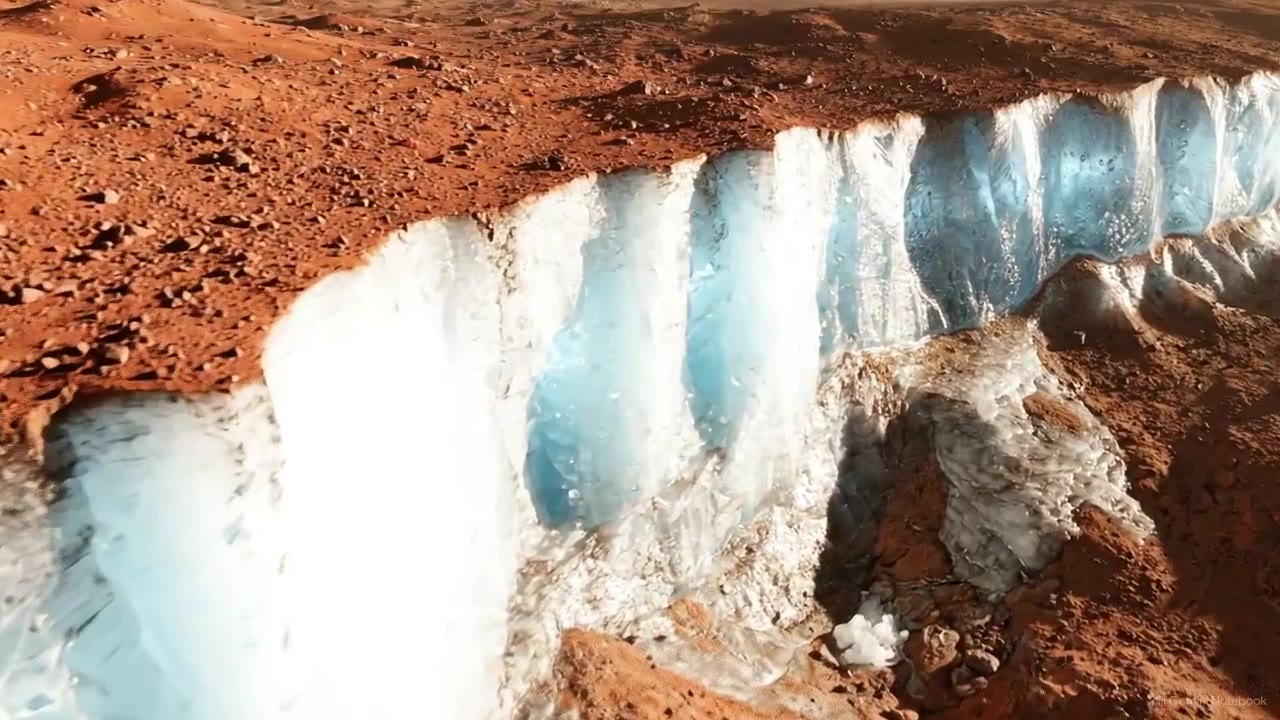
Regions such as Arcadia Planitia, between roughly 20 and 30 degrees latitude, are the narrow compromise where landing safety and ice presence partially overlap. Even there the ice has retreated underground, typically buried under a mantle of dry regolith. Phoenix showed the configuration clearly: white ice under red soil. That creates an operational contradiction. A spacecraft of Starship’s mass must land on firm, relatively solid ground to avoid tipping. Mining equipment must operate in loose surface material to reach the ice. The engineering problem shifts from horizontal distance to vertical depth. Stripping meters of toxic, abrasive Martian regolith at industrial scale wants continuous high power — most plausibly surface nuclear reactors that do not yet exist.
The physics wall
Industrial progress often hits a cost wall where further advances become exponentially more expensive — the semiconductor industry’s fight with ever-smaller features is the familiar case. Martian ISRU hits a comparable barrier the moment heavy robotics must excavate and process large volumes of surface material. Heat-shield performance, orbital propellant transfer, and autonomous navigation are necessary. None of them move dirt under the landing zone. The paradox is therefore sharp: the most sophisticated flight system yet designed remains dependent on brute-force surface excavation. Navigation across interplanetary distances happens in a near-frictionless vacuum. Success on the surface is constrained by the last few meters of Martian dust.
What has to close
The bottleneck is not conceptual. Water exists in quantity. Chemical pathways for propellant synthesis are understood. The limiting factors are geographic distribution, the physical properties of the overburden, the power density required for industrial extraction, and the current absence of flight-ready nuclear surface systems. Until those surface challenges are solved at scale, Starship’s mass and performance advantages cannot fully translate into sustainable, high-capacity traffic between Earth and Mars. The path to a permanent human presence beyond Earth runs directly through the engineering of those final meters of dust.
Polar ice volume (km³)
Polar ice volume: north polar layered deposits 780,000 cubic kilometers; south polar layered deposits 1,600,000 cubic kilometers.
| Item | Value |
|---|---|
| North polar layered deposits | 780,000 km³ |
| South polar layered deposits | 1,600,000 km³ |
Ask this paper
Grok answers from this essay only. Sign in so the call stays on your session — one question at a time.
Sign in to askNext
The First Breath