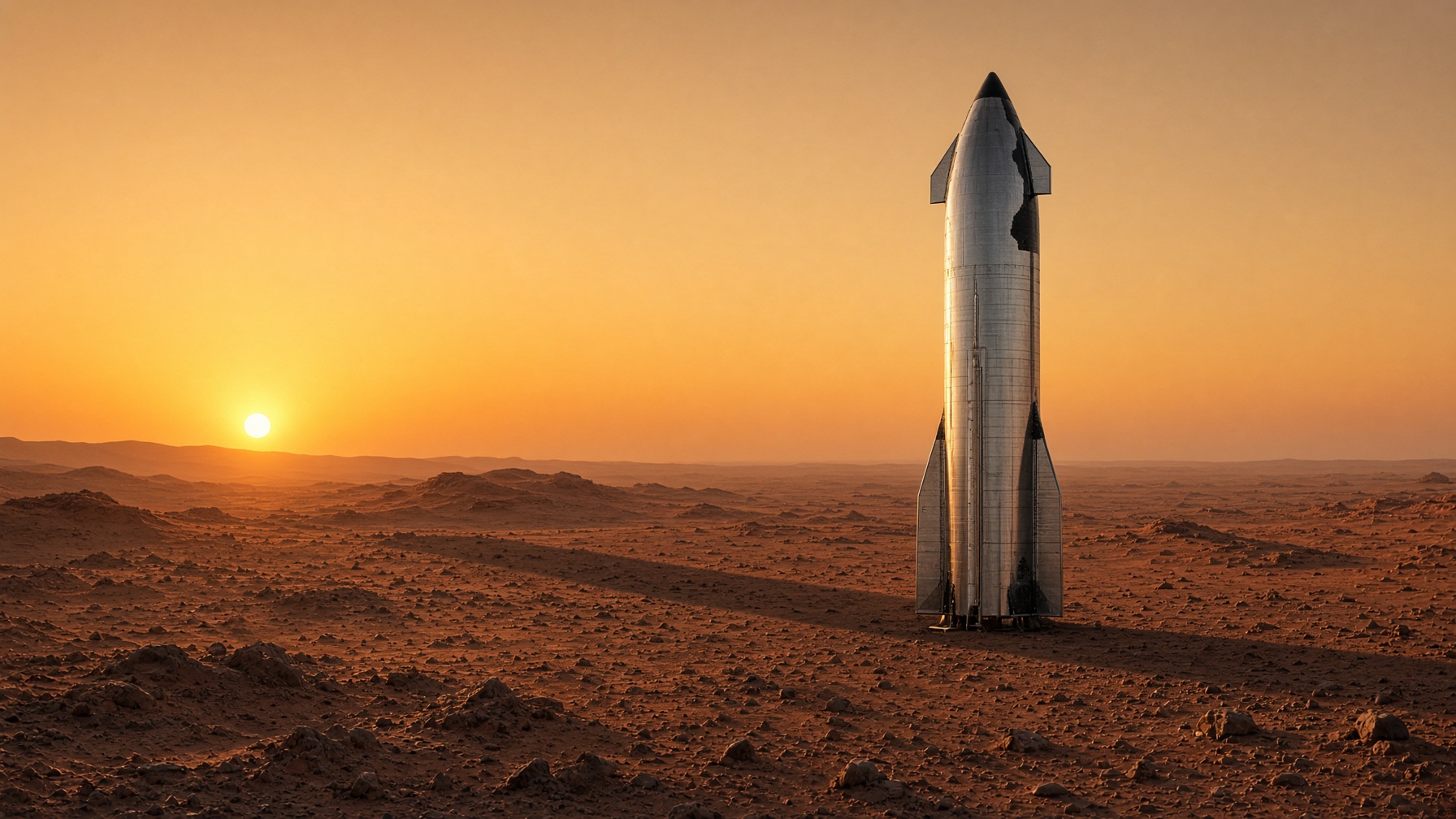
The load
A self-sustaining outpost is bound to in-situ resource utilization. You do not ship return propellant from Earth. A crew of 12 on a partially closed-loop ECLSS needs ~100 kW continuous. Scale to 100 people and life support climbs to 2.0–2.5 MW. The real bottleneck is propellant: 1,200 metric tons of cryogenic LOX/LCH4 per Starship, 2,400 MT for a two-ship return. Sabatier methanation plus electrolysis, CO2 cryocapture, soil baking, and cryogenic liquefaction draw 3.37–3.40 MW over a 470-day production window. Assuming ~15% hydrated minerals in mid-latitude regolith, mining systems must excavate and bake about 33 MT of soil per day to feed the hydrogen loop. Total surface demand: ~3.6 MW.
Why solar breaks at industrial scale
Mars sits at 1.52 AU. Solar intensity falls with the square of distance, from ~1,361 W/m² at Earth to ~590 W/m² at Mars. Atmosphere and dust take more. Night is 12.3 hours. Global dust storms can last months and drop generation 90–95%. A 100 kW overnight life-support reserve already wants a ~600 kWh battery bank (~9.5 MT); megawatt-scale ISRU makes the mass penalty grotesque. Deployable arrays at this scale are 60–80 meters across for a 2.5 MW habitat load, with stowage canisters 20–30 meters long. Mechanical deployment from a Starship nose cone is a high-probability failure mode. Fine electrostatic dust accumulates and wants active cleaning.
Fission surface power
Two modular 2 MW fission surface power systems meet the 3.6 MW baseload. Each unit is projected at 32 MT including core, Stirling conversion, electronics, and shielding — 64 MT for the pair, inside Starship’s nominal 100 MT payload. Highly enriched uranium, liquid-metal heat pipes, Stirling engines. Continuous 24/7 output, independent of solar distance, night, latitude, dust, and storms. No massive battery farm. Steady thermal equilibrium for cryocoolers.
The TRL gap and the hybrid path
Kilopower/KRUSTY class 10 kW reactors have been tested on Earth. Megawatt-class surface reactors remain TRL 3–4 and likely need a decade of dedicated development, plus launch locks so the core stays subcritical through ascent abort, plus regolith berms and long high-voltage cable runs. The honest architecture is hybrid. Phase 1, uncrewed prospecting: deployable solar. A blackout only pauses robots. Phase 2, first crews: fission units must already be running, because return propellant has to be largely synthesized before anyone leaves Earth. Only nuclear gives the guaranteed 5.1 MT/day Sabatier rate. Space nuclear power is not an upgrade. It is the enabler that turns a flag-planting into a civilization.
Surface power draw (MW)
Surface power draw: ISRU plant 3.38 megawatts, crew of 12 at 0.1 megawatts, 100-person ECLSS 2.25 megawatts.
| Item | Value |
|---|---|
| ISRU plant | 3.38 MW |
| Crew of 12 | 0.1 MW |
| 100-person ECLSS | 2.25 MW |
Ask this paper
Grok answers from this essay only. Sign in so the call stays on your session — one question at a time.
Sign in to askNext
The First Breath