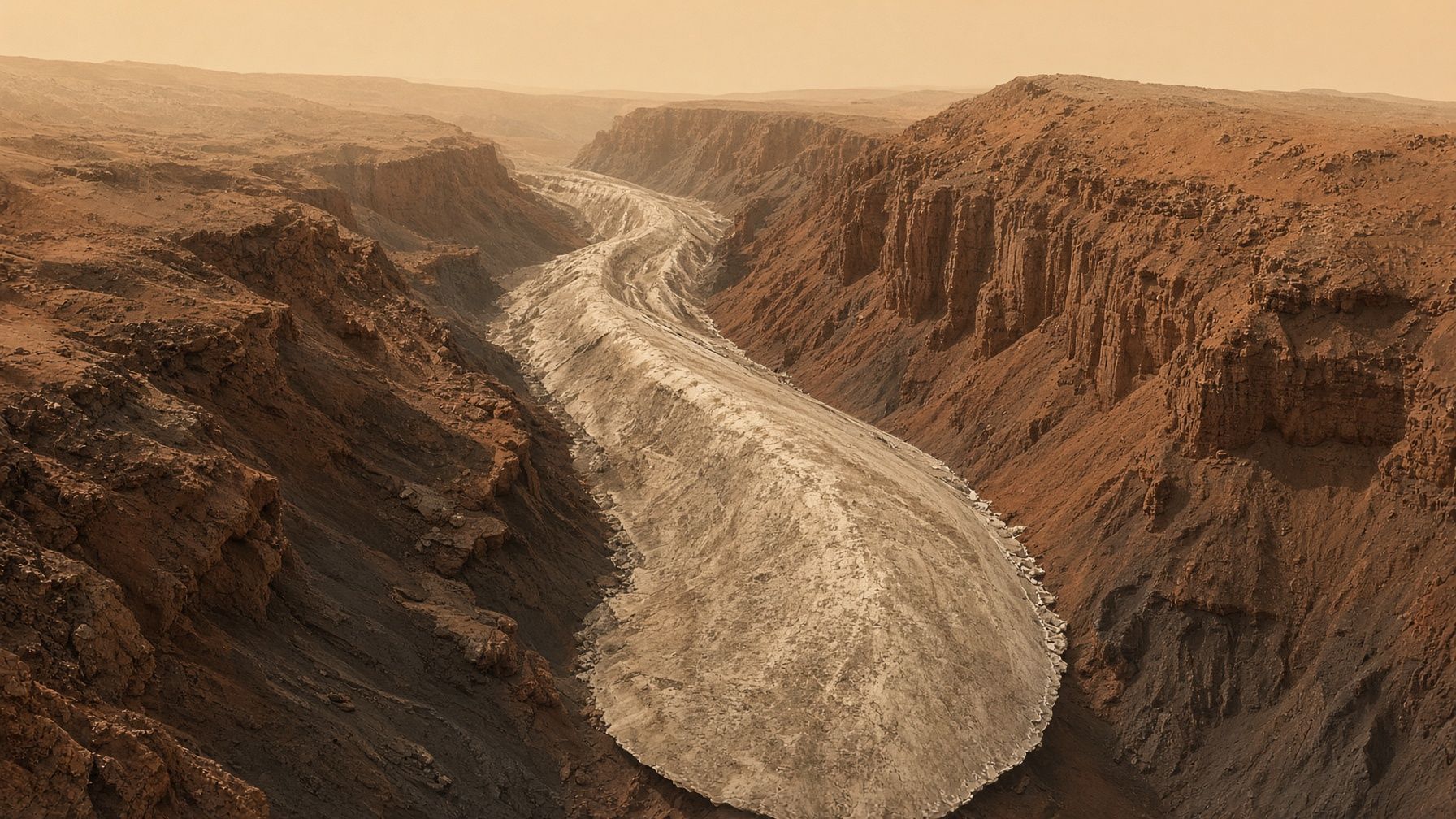
How much ice is actually there
Present-day exchangeable water ice — polar layered deposits plus near-surface ground ice at mid-to-high latitudes — totals roughly 20–30 meters global equivalent layer. Melt it all and spread it evenly and you get a 20–30 m ocean. The north polar layered deposits alone hold about 780,000 km³ of mostly pure ice; the south polar deposits hold even more, around 1.6 million km³. Additional ice sits in mid-latitude glaciers and buried deposits. Mid-latitude dust-mantled ice is the practical goldmine: no polar night, real volume, ready for ISRU.
How the loss process actually works
Water does not just evaporate into space. Seasonal sunlight heats polar ice; some sublimates to vapor. Most of that vapor stays low and re-freezes somewhere else — the water cycle is still active, just very slow and cold. A small fraction is lofted higher. Above ~40–60 km, ultraviolet sunlight photolyzes H2O into hydrogen and oxygen. Light hydrogen can reach escape velocity via Jeans escape. Oxygen is lost more slowly through sputtering and ion pickup.
Current rates are tiny
MAVEN shows hydrogen escape averaging around 3 × 10²⁶ atoms per second (seasonally ~1–11 × 10²⁶). That is only a few hundred grams of hydrogen per second at peak — a few kilograms of water per second if all of it came from H2O. Total atmospheric gas loss is in the 1–3 kg/s range. Losing just 1 meter of global equivalent water at these rates would take on the order of hundreds of millions of years. Depleting the current 20–30 m inventory would require billions of years. Even exposed polar scarps retreating a few meters per thousand years do not dent the bulk reservoirs. Most of the ice is buried under dust, locked in cold traps, or cycling on 10⁵–10⁶ year obliquity timescales.
What this means for settlement
Past rates were higher, which is why Mars has already lost tens to hundreds of meters GEL. Under present conditions the ice is not vanishing on any timescale that matters for human exploration. The real challenges are still getting there, landing, and figuring out how to extract and use what is already waiting. Atmospheric stripping by solar wind is incredibly slow. If we thickened the atmosphere today, it would stay stable for human civilization for millennia even without a magnetic shield.
Polar ice volume (km³)
Polar ice volume: north polar layered deposits 780,000 cubic kilometers; south polar layered deposits 1,600,000 cubic kilometers.
| Item | Value |
|---|---|
| North polar layered deposits | 780,000 km³ |
| South polar layered deposits | 1,600,000 km³ |
Ask this paper
Grok answers from this essay only. Sign in so the call stays on your session — one question at a time.
Sign in to askNext
The First Breath