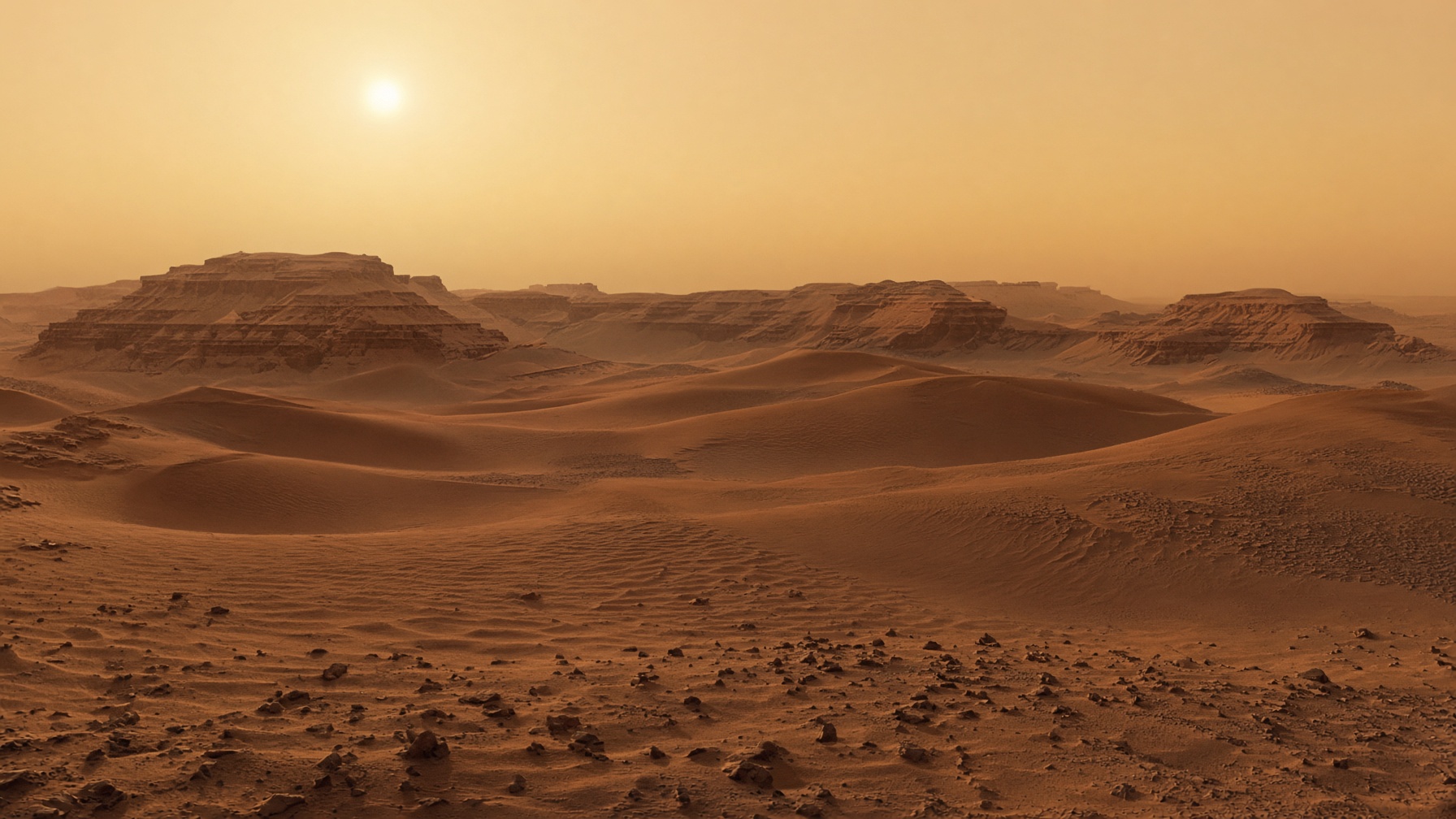
The only nearby body that can close the loop
Mars is the only nearby celestial body where a self-sustaining civilization can be engineered rather than sustained by perpetual resupply from Earth. The Moon remains accessible, but vacuum, 28-day temperature cycles, and immediate dispersal of any locally generated gases defeat economic independence. Biological and mechanical systems cannot survive the prolonged lunar night without energy infrastructure whose mass and complexity eat the business case.
What Mars already has
Mars starts with a thin CO2 atmosphere and accessible water ice. Its gravity retains added volatiles over relevant timescales. Its 24.6-hour day aligns with agriculture and solar power without massive storage buffers. Land mass is 97% of Earth’s. Surface gravity is about 38% of Earth’s — manageable for sustained operations. Geological evidence shows a thicker atmosphere and liquid oceans in the past. Warming Mars could restore both. That is a physically coherent objective given the planet’s existing mass and composition.
The decisive variables
Atmospheric retention and cycle compatibility. Mars satisfies both. The Moon satisfies neither. Accessibility is not the same as settleability. The 26-month transfer window is slower than a lunar hop, which is why uncrewed cargo and Optimus have to go first — but the destination is the one that can eventually stop depending on Earth.
Ask this paper
Grok answers from this essay only. Sign in so the call stays on your session — one question at a time.
Sign in to askNext
The First Breath