Starship · Architecture · Hardware · 9 min read
Two Gigabays
Three hundred and eighty feet. Twenty-four cells. Four hundred tons on the hook. Florida and Texas, both targeted for the end of 2026. A hall is not a cadence.
A hall is not a cadence
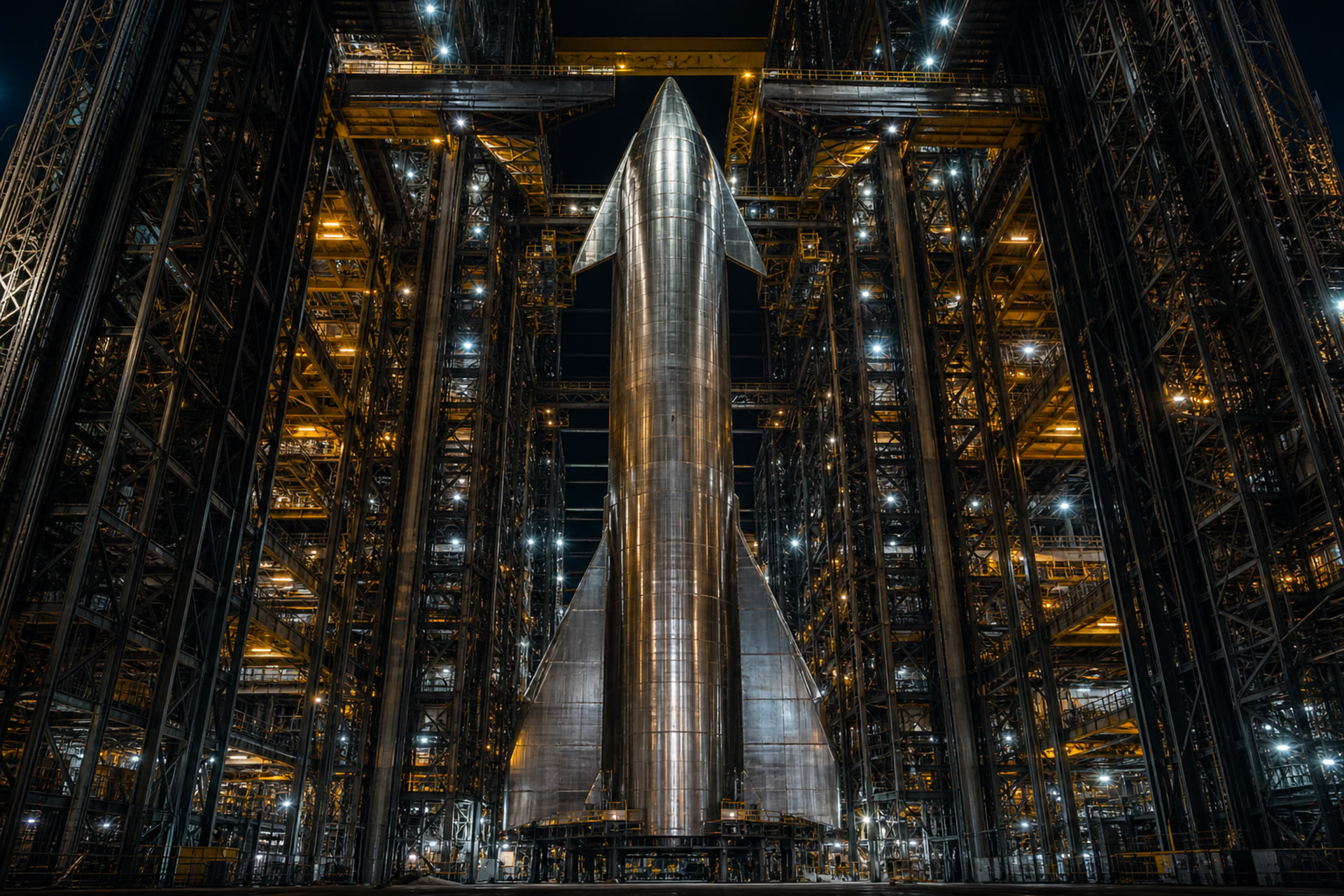
On 3 March 2025 SpaceX published the buildings. Flight testing stays at Starbase. A new integration facility called Gigabay goes up next to HangarX at NASA’s Kennedy Space Center. A second Gigabay goes up at Starbase, next to Starfactory. Both were targeted to be complete and operational by the end of 2026. Site work had already begun on both. This desk is writing in August 2026. It will not invent a ribbon-cutting the page did not print. The point of the halls is rate. Expansion in Florida, SpaceX wrote, lets the company raise build and flight rates for the first rapidly and fully reusable launch vehicle. Starship will ultimately send millions of tons of payload to Mars and build a self-sustaining city. A hall is how a window gets a fleet. A hall is not a city, and a targeted date is not an open door.
Eleven times the Megabay
The Florida Gigabay will stand 380 feet tall. About 46.5 million cubic feet of interior processing space. 815,000 square feet of workspace: ground level, elevated platforms, a work and meeting floor at the top. It can take Starship and Super Heavy vehicles up to 81 meters (266 feet) tall. Twenty-four work cells for integration and refurbishment. Cranes that lift up to 400 US tons. Against the Megabays at Starbase — then SpaceX’s largest stacking and integration buildings — Gigabay is more than eleven times the workspace, nineteen additional cells, and more than twice the crane capacity. Those are building numbers. They are not a flown hour and they are not a thousand hulls a year. The vehicle page still claims Starfactory is sized for up to 1,000 Starships a year. A Gigabay is the stacking and refurbishment half of that sentence. Catch without a cell to strip and restack is a one-shot booster.
- Height — 380 ft
- Volume — ~46.5 million cu ft
- Workspace — 815,000 sq ft
- Vehicles — up to 81 m (266 ft)
- Cells — 24 for integration and refurbishment
- Cranes — up to 400 US tons
- Versus Megabay — >11× workspace, +19 cells, >2× crane
Barge first, factory later
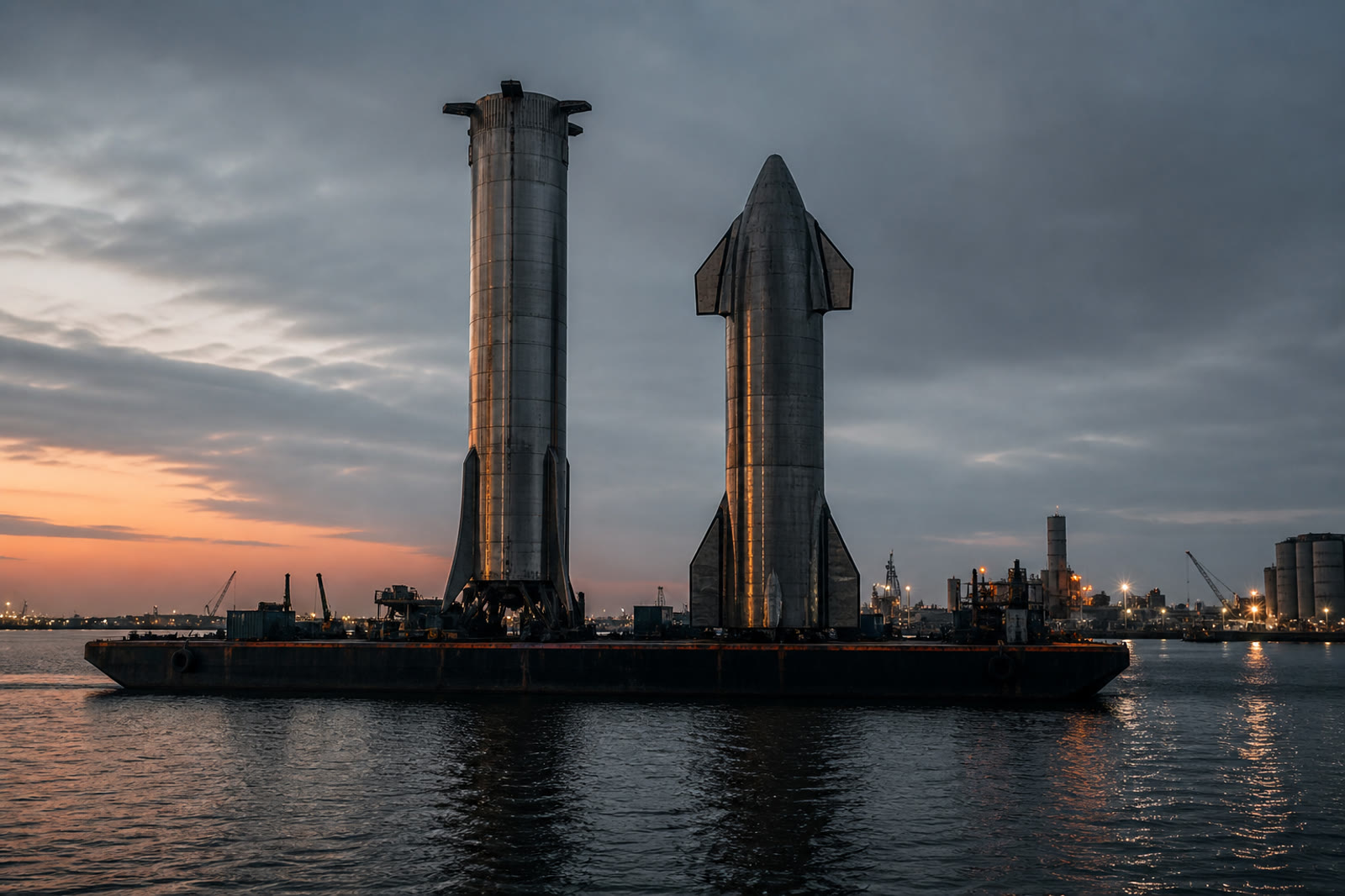
While Florida’s Gigabay is built, SpaceX is designing a co-located manufacturing plant like Starfactory so ships can be printed on the Space Coast. Until those plants exist, completed Super Heavy boosters and Starship upper stages move from Starbase by barge to stand up a Florida fleet. Two coasts with production, integration, refurbishment, and launch is how rapid reuse becomes a rate instead of a stunt. The October 2025 lander page put the same industrial sentence in square footage: more than five million square feet of manufacturing and integration space, five launch pads across Texas and Florida, multiple Raptor stands, billions in private money. That is the plant that is supposed to outrun Falcon’s cadence. A barge is the bridge. It is not the factory.
39A, then maybe 37
Initial Florida launches need a catch site at LC-39A. That pad takes learnings from Starbase’s first two. The tower at 39A was stacked in 2022. A deflector for cooling and sound-suppression water — nearly identical to Pad 2’s — was still to be built and installed when the March page ran. Pending environmental reviews, SpaceX intended Starship’s first Florida launch from 39A in late 2025. This desk will not invent whether that launch happened. It will keep the sentence dated. The tanker math is why a second Florida pad is even a sentence. Making life multiplanetary, the page said, needs cargo, people, and the tankers that fill ships in orbit. SpaceX was given a limited Right of Entry at SLC-37 to support due diligence for an Environmental Impact Study, led by the Department of the Air Force, for Starship and Super Heavy at Cape Canaveral Space Force Station. SLC-37 is Apollo-era Saturn I/IB ground, later Delta IV through 2024. A right of entry is not a pad. An EIS is not a catch.
- LC-39A — Starship launch and catch; tower stacked 2022; Pad-2-class deflector
- First Florida launch — intended late 2025 on the 3 March 2025 page; unpublished here as flown
- SLC-37 — limited Right of Entry; Air Force-led EIS; not a awarded pad
- Why two pads — cargo, crew, and tankers for on-orbit refill
The desk load
V3 is the vehicle. Terafab is the die. Gigabay is the room you restack the vehicle in after you catch it. Miss any one and the 100 GW year does not close. The 2026 gates have not moved. Long duration. Ship-to-ship transfer. Without the transfer, Starship stays a heavy-lift vehicle. Ice, 2,400 tonnes of return propellant, and 3.6 megawatts of surface baseload have not moved. This paper is the 3 March 2025 plant list. Two halls. End of 2026, targeted. A barge across the Gulf until Florida can print its own stainless. 39A as the first Florida catch. 37 as a study. A hall is not a cadence. A cadence is not a city.
Selected primary sources
SpaceX Updates, “FUTURE OF BUILDING STARSHIP,” 3 March 2025, https://www.spacex.com/updates/building-starship. SpaceX Updates, “To the Moon and Beyond,” 30 October 2025, https://www.spacex.com/updates/moon-and-beyond. SpaceX, “Starship,” https://www.spacex.com/vehicles/starship. The 3 March 2025 desk is the source for both Gigabays targeted end of 2026, the 380 ft / 46.5 million cu ft / 815,000 sq ft / 24-cell / 400-ton / 81 m numbers, the 11× Megabay comparison, barge-from-Starbase until a Florida Starfactory exists, LC-39A catch-site plans and a late-2025 first-Florida-launch intent, and SLC-37’s limited Right of Entry under an Air Force-led EIS. The October 2025 page is the source for more than five million square feet and five pads. SpaceX has not published, on these pages, that either Gigabay is operational. This desk will not borrow a ribbon-cutting.
Ask this paper
Grok answers from this essay only. Sign in so the call stays on your session — one question at a time.
Sign in to askNext
Starbase, Louisiana