Mars · Curiosity · Sulfur · Gediz Vallis · 12 min read
The Rock That Broke Open Mars
Curiosity’s wheel fractured an ordinary stone in Gediz Vallis and exposed yellow crystals no mission had confirmed on Mars: native elemental sulfur.
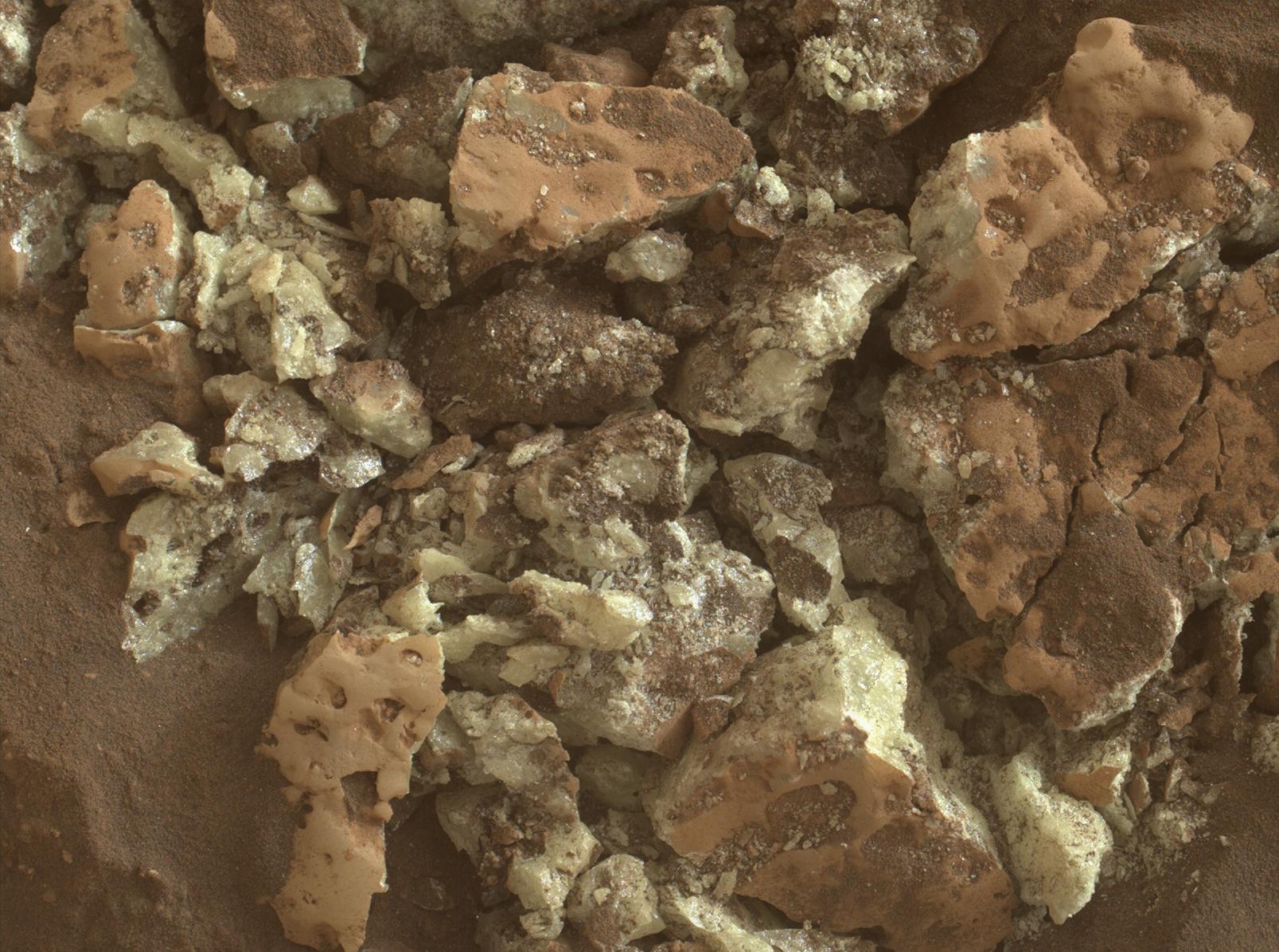
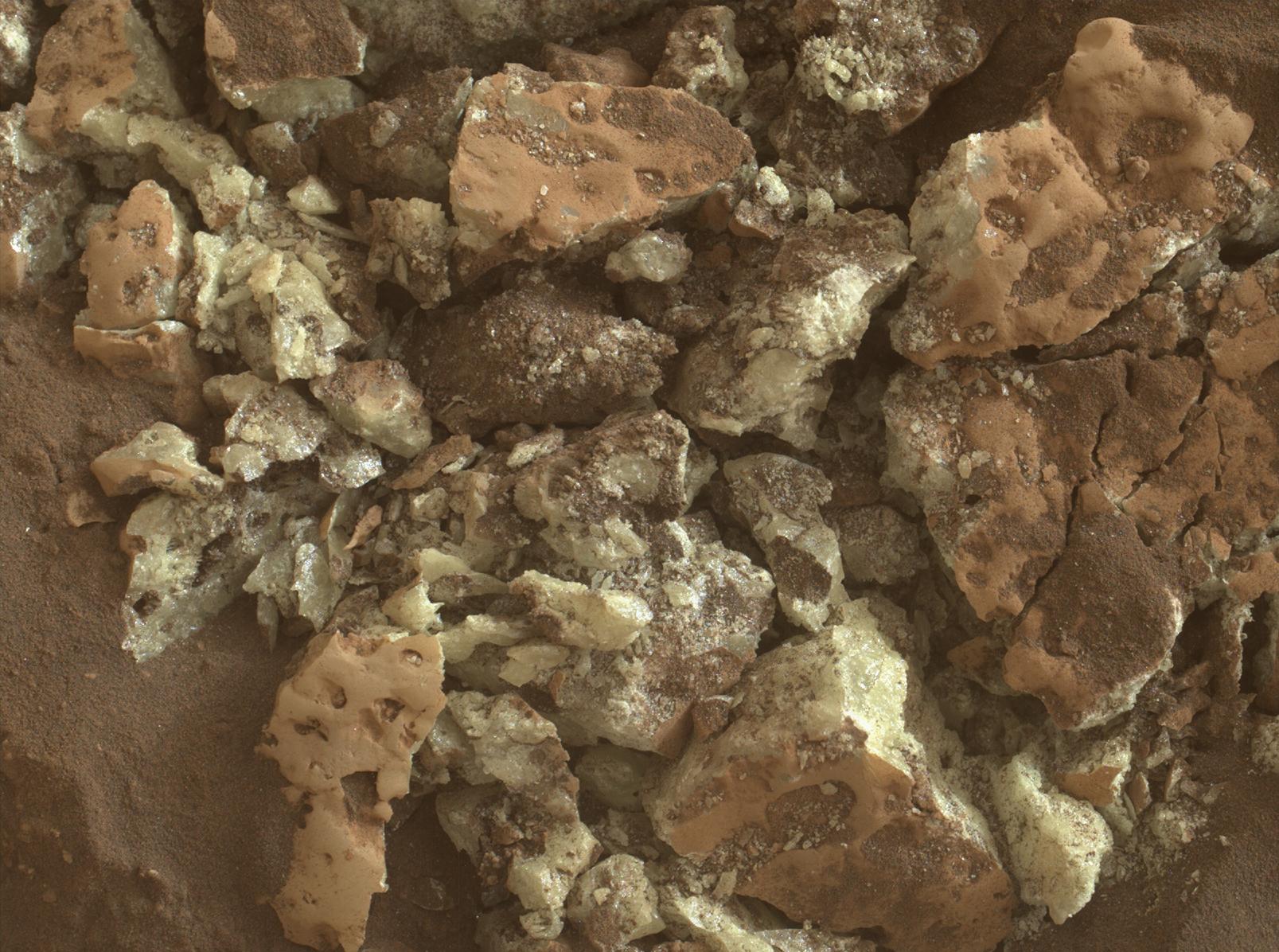
On May 30, 2024, the Curiosity rover drove across a field of pale stones inside Gediz Vallis, a channel cutting through the northern slope of Mount Sharp in Gale Crater. One of the stones shattered beneath a wheel. Through the newly opened fracture, Curiosity’s cameras saw something unexpected: a mass of yellow, crystalline material concealed beneath the rock’s weathered exterior.
Mars is rich in sulfur compounds. Curiosity, Opportunity, and other robotic explorers have encountered sulfate salts and sulfur-bearing minerals across the planet. But these crystals were different. They were not sulfur chemically bound to magnesium, calcium, iron, or another element. Measurements made by Curiosity showed that the fractured stone contained native sulfur — sulfur in its elemental form. No previous mission had confirmed a deposit like it on Mars.
The rock, nicknamed “Convict Lake,” was not an isolated curiosity. Surrounding it was an entire field of similarly bright stones. The discovery transformed a minor driving incident into a major geological investigation — and raised a question that scientists are still working to resolve: what process produced a concentrated field of nearly pure sulfur inside an ancient Martian canyon?
The discovery Curiosity was never designed to make
Curiosity did not arrive at the sulfur field because scientists had detected elemental sulfur from orbit. Images taken by NASA’s Mars Reconnaissance Orbiter showed only an apparently ordinary patch of light-colored ground. The individual stones were too small to be resolved clearly by even the orbiter’s HiRISE camera. The discovery required a rover on the surface.
As Curiosity entered the area, its Mastcam cameras revealed a sloping, triangular field scattered with bright cobbles. The unexpected terrain prompted the mission team to alter the rover’s planned route and begin a six-week investigation along the field’s margin. Then the rover wheel opened Convict Lake. Curiosity returned on June 4, 2024 — mission sol 4,205 — to photograph the fractured material with the Mars Hand Lens Imager, MAHLI, mounted on the robotic arm. The rover’s Alpha Particle X-Ray Spectrometer was placed against the material. APXS found an extraordinary concentration of sulfur without the abundance of companion elements expected if the material were an ordinary sulfate salt. The combined chemical and visual evidence identified the crystals as elemental sulfur.
Curiosity later examined another pale stone called “Snow Lake.” Its crystalline interior resembled the material exposed in Convict Lake, reinforcing the conclusion that the rover had encountered a deposit rather than a single anomalous fragment. NASA initially described the discovery as an “oasis in the desert” — not because the sulfur was evidence of life or liquid water, but because it was an unexpected concentration of material in a geological setting where scientists had not predicted it.
This was not just another sulfate
The distinction between a sulfate and native sulfur is central to the discovery. In sulfates, sulfur exists in a highly oxidized state and is chemically bonded with oxygen and other elements. Gypsum is a calcium sulfate. Magnesium sulfates are widespread in the layers Curiosity has been exploring higher on Mount Sharp. Those salts commonly form when sulfur-bearing water evaporates or when groundwater alters existing rocks. Native sulfur is different. It consists primarily of sulfur atoms in the zero oxidation state, written chemically as S⁰.
- Reduced sulfide → elemental sulfur → oxidized sulfate
- Moving sulfur between these states requires specific chemical conditions
- On Earth: volcanic vents, hydrothermal systems, hot springs, salt deposits, sulfur-rich fluids reacting with oxidants
- Microorganisms can participate — purely geological reactions can produce the same material
That is why the Martian discovery is scientifically provocative without being evidence of biology. It indicates that an unusual set of chemical conditions once existed at Gediz Vallis. Determining those conditions could reveal how heat, water, gases, ice, and reactive minerals interacted late in Gale Crater’s history.
A field, not a fragment
Early descriptions focused on the stone crushed by Curiosity. Subsequent analysis showed the larger setting may be even more important than the broken rock. The bright cobbles occupied a triangular area estimated at roughly 1,200 square meters during the rover team’s Keyhole Wall investigation. Later geological analysis described decimeter-scale, pale, pitted blocks spread across a region approximately 50 meters wide. The stones were concentrated within a sinuous, entrenched canyon cut into the floor of Gediz Vallis. Researchers concluded that the sulfur probably formed locally rather than being carried a great distance from somewhere else.
That conclusion narrows the geological problem. Scientists are no longer trying to explain a loose meteorite-like object or an isolated mineral fragment. They must explain a coherent sulfur-forming environment inside the canyon. Curiosity’s nearby drill target, “Mammoth Lakes,” added another constraint. On June 18, 2024, the rover drilled its 41st hole into this larger, more stable rock. Native sulfur was not detected in that drilled sample. The sulfur therefore does not appear to be distributed uniformly through all local bedrock. It occupies a specific deposit with boundaries, textures, and a history of its own.
Gediz Vallis: a record of Mars after the lakes
The channel extends roughly 10 kilometers through Mount Sharp and reaches approximately 800 meters across and 75 meters deep in places. It formed relatively late in the mountain’s history, after many of the older lake sediments lower on Mount Sharp had already hardened into rock. Curiosity’s observations indicate that Gediz Vallis was not shaped by a single event.
- Dry rock avalanches and landslides
- Water-rich debris flows
- Rivers or floodwaters capable of transporting and rounding stones
- Groundwater alteration along cracks and rock boundaries
- Long periods of wind erosion that later exposed buried deposits
This mixture matters because it shows that Mars did not pass cleanly from wet to dry in one planetary moment. Even as the overall climate became colder and more arid, water apparently returned intermittently — moving through channels, soaking debris, altering rock, and possibly circulating below the surface. A 2026 analysis of Gediz Vallis concluded that late-stage debris flows helped erode Mount Sharp and that both surface water and groundwater remained available after much of the mountain had already been exhumed. The sulfur deposit sits within this complicated sequence. It may preserve evidence of one of the later episodes of chemical activity accessible to Curiosity.
How could native sulfur form there?
When NASA announced the discovery in July 2024, the formation mechanism was unknown. On Earth, visible deposits of native sulfur often occur near volcanoes and hot springs, yet Curiosity had not found clear evidence that either environment existed at this particular location. By 2026, researchers had developed more detailed formation models.
Magmatic vapor beneath a frozen surface
The first peer-reviewed analysis of the deposit, published in Science in 2026, concluded that the stones are composed of native sulfur and that the deposit likely formed in place within the entrenched canyon. The researchers proposed that sulfur-bearing magmatic vapor may have risen from depth and cooled within Mars’ near-surface cryosphere — the zone where water was frozen in the ground. Under this model, sulfur-bearing gases became trapped or converted into sulfur-rich material below the surface. As Gediz Vallis was later cut, eroded, and unloaded, decreasing pressure could have released sulfur-bearing material into the canyon deposit. Continued erosion eventually exposed the stones at the surface. The model does not require an obvious volcanic vent beside the rover. It points to a deeper and potentially older source, followed by burial, decompression, alteration, and exhumation.
Sulfide oxidation by Martian chlorate
A second pathway received experimental support in July 2026. Researchers tested whether aqueous sulfide could react with chlorate, an oxidizing chlorine compound relevant to Martian chemistry. In oxygen-free laboratory experiments conducted under strongly acidic conditions, the reaction produced both elemental sulfur and sulfate. This was the first experimental demonstration that chlorate-driven oxidation of dissolved sulfide could create elemental sulfur without biology. Applied to Gediz Vallis, the reaction would require a sustained source of sulfide, a limited supply of chlorate, and at least temporary liquid water or brine. The experiment demonstrates that such a pathway is chemically possible; it does not prove that these exact conditions created Curiosity’s sulfur field.
The two models are not necessarily incompatible. A magmatic or subsurface process could supply reduced sulfur, while later water-rock reactions involving Martian oxidants could transform or redistribute it. Establishing the exact sequence will require linking the sulfur to the canyon’s physical stratigraphy and to surrounding minerals.
What the sulfur means for habitability
Sulfur is essential to life on Earth. It is incorporated into amino acids, proteins, enzymes, and cellular energy pathways. Some terrestrial microorganisms obtain energy by oxidizing reduced sulfur or reducing sulfate. But the presence of sulfur — even native sulfur — is not itself a biosignature. No fossil, biological texture, diagnostic organic compound, or uniquely biological sulfur-isotope pattern has been identified in these stones. The known geological mechanisms are sufficient to explain elemental sulfur without invoking life.
The discovery remains relevant to habitability for a different reason. Habitability depends not only on water but on usable chemical energy, essential elements, environmental stability, and the movement of fluids through rock. A landscape capable of cycling sulfur through several oxidation states may have provided chemically diverse environments. Gediz Vallis also records intermittent water activity during a period when Mars was trending toward its modern dry state. If sulfur-bearing fluids circulated underground, they may have created localized environments that remained chemically active after surface lakes had disappeared. That possibility makes the deposit important to the reconstruction of Mars’ environmental decline, even if the sulfur ultimately proves to be entirely abiotic.
Evidence boundary
The claim has a hard edge. What is known, what is argued, and what has not been shown should stay separate.
- Confirmed: Curiosity encountered a field of stones composed largely of native elemental sulfur — the first such deposit identified on Mars.
- Strongly supported: the deposit formed locally within an entrenched portion of Gediz Vallis and was later exposed by erosion.
- Still under investigation: the sulfur’s original source and the exact sequence of vapor movement, freezing, water-rock reaction, oxidation, burial, and decompression.
- Not established: the presence of life, a biosignature, an active volcanic vent, or an ancient hot spring at the rover’s location.
Why the accident matters
The sulfur discovery illustrates a persistent limitation of exploring Mars from orbit. A spacecraft can map kilometers of terrain, identify broad mineral units, and reveal channels, deltas, fractures, and buried ice. But some of the planet’s most consequential evidence exists at the scale of individual stones — or inside them. From orbit, the sulfur field looked like an unremarkable bright patch. From the ground, it became a geological anomaly. Only after a wheel applied pressure and fractured a stone did the decisive interior texture become visible.
This does not mean planetary exploration should depend on accidents. It means future missions should be designed to exploit contact, mobility, abrasion, drilling, trenching, and microscopic imaging. Freshly exposed surfaces often preserve information that radiation, dust, and billions of years of weathering have erased from the exterior. The discovery also demonstrates the value of a mobile scientific laboratory. Curiosity could recognize the unusual terrain, change its route, approach the stones, place instruments against them, image their crystals, and investigate surrounding geology. No single orbital measurement could have reconstructed the same story. Future robotic and human explorers will need comparable flexibility. The most important target may not be the feature selected before landing. It may be the ordinary-looking stone that breaks under a wheel.
The questions Curiosity left behind
Curiosity examined the sulfur field from multiple angles before departing Gediz Vallis in late 2024. The rover gathered panoramas, close-up images, chemical measurements, and geological context, but the brittle sulfur stones were poorly suited for conventional drilling.
- What was the original sulfur source — magmatic vapor, sulfide-bearing groundwater, or both?
- When did the deposit form relative to channel incision, debris flow, and burial?
- What oxidants were present — chlorates, perchlorates, iron minerals, or others?
- How extensive is the deposit below the surface?
- What would laboratory analysis of a returned sample — mineral structure, trace elements, sulfur isotopes — decide among the models?
A yellow fracture in a red world
Curiosity’s sulfur discovery is powerful precisely because it is not a simple answer. The crystals do not prove that Mars once carried life. They reveal that the planet’s chemistry remained capable of producing concentrated, unexpected materials within a landscape already marked by climatic decline. A pale stone broke open, and inside it was evidence of a sulfur cycle scientists had not known how to place within Mars’ history. The discovery reframes Gediz Vallis as more than a channel carved during the planet’s fading wet era. It is a site where avalanches, floods, groundwater, erosion, and possibly deep sulfur-bearing gases converged across time. Mars often hides its most important records behind weathered surfaces. In this case, uncovering one required no carefully aimed drill and no planned sampling maneuver. It required a wheel, a brittle stone, and the chance to see what had been sealed inside.
Selected primary sources
NASA Jet Propulsion Laboratory, “NASA’s Curiosity Rover Discovers a Surprise in a Martian Rock,” July 18, 2024. NASA Science, “Curiosity Captures Close-Up of Sulfur Crystals,” PIA26307, July 19, 2024. NASA, “Curiosity Mars Rover Takes a Last Look at Mysterious Sulfur,” November 18, 2024. VanBommel et al., “A Native Sulfur Deposit in Gale Crater, Mars,” Science, 2026, DOI: 10.1126/science.adu5501. Wang et al., “Oxidation of Aqueous Sulfide by Chlorate: Implications for Native Sulfur Formation on Mars,” Geophysical Research Letters, 2026, DOI: 10.1029/2025GL121494. Davis et al., “Late-Stage Debris Flows Eroded Aeolis Mons in Gediz Vallis, Gale Crater, Mars,” Journal of Geophysical Research: Planets, 2026, DOI: 10.1029/2025JE009538. Wilson et al., “Curiosity’s Keyhole Wall Campaign: Investigating the Upper Gediz Vallis Ridge in Gale Crater,” 56th Lunar and Planetary Science Conference, 2025.
Ask this paper
Grok answers from this essay only. Sign in so the call stays on your session — one question at a time.
Sign in to askNext
The First Breath