A planetary-scale imbalance
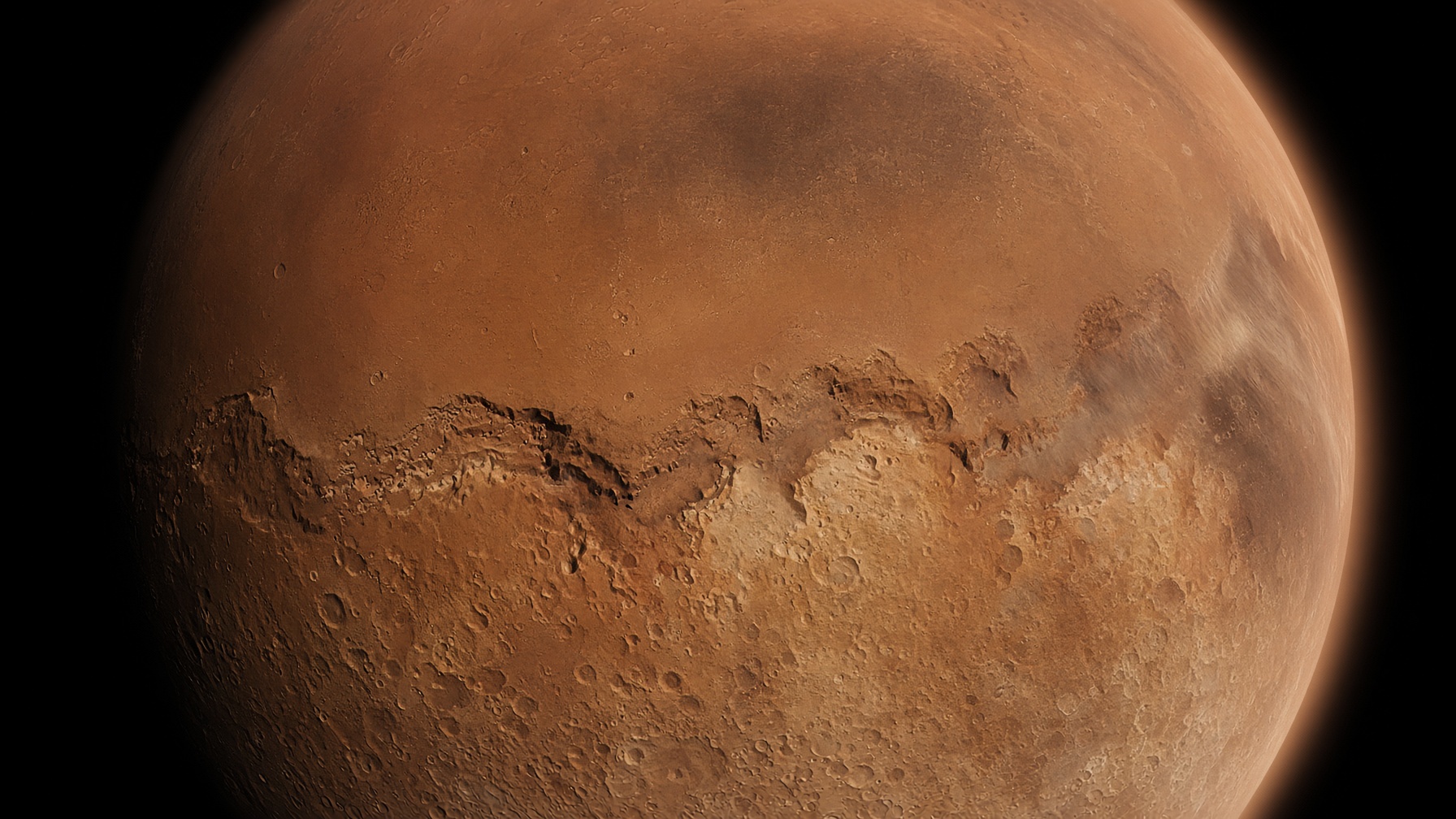
Mars is a planet of two halves, and its lopsided nature is the single greatest clue to its violent past. The thickness of a planet’s crust is not merely a geological statistic; it is a high-resolution record of the cataclysmic events that defined the early solar system. When we look at Mars, we see a world where the northern and southern hemispheres tell two completely different stories. The most jarring evidence of this is a 32 km difference in crustal thickness between the two halves. This structural asymmetry — the Martian Dichotomy — reveals that the Red Planet was fundamentally reshaped over 4 billion years ago, creating a geological scar that dictated the fate of its atmosphere.
Hard data
Geological measurements reveal the internal health and history of a planet. Variations in crustal thickness are the primary drivers of elevation changes and gravitational anomalies. Recent geophysical models and 2025/2026 rover data provide a stark picture of these extremes.
- Global average crust: 42–56 km
- Minimum: Isidis Planitia, thinned to 6 km
- Maximum: Tharsis plateau, up to 117 km
- Elevation gap: ~5 km between northern lowlands and southern highlands
The missing carbon sink
This gap created the low-elevation warm spots required for liquid water. As confirmed by Curiosity (Tutolo et al., 2025), these basins became traps for cryptic carbonates — iron carbonates like siderite that are invisible to orbital spectroscopy. The lopsidedness governed the planet’s limit cycle, parceling out its CO2 endowment into localized oases that lasted less than 100,000 years before the atmosphere was scrubbed too thin to sustain warmth. Unlike Earth, Mars is a single-plate planet with a stagnant-lid tectonic style. Research published in 2025 (Kite et al.) highlights that this lack of active plate tectonics meant Mars could not recycle carbon back into the atmosphere through subduction and volcanism. Liquid water in the lowlands reacted with atmospheric CO2 through in situ carbonation, entombing the gas as carbonate minerals. The stagnant lid prevented those rocks from being recycled. The dichotomy acted as a planetary-scale carbon trap.
Theory 1 — Exogenic impact
The leading contender for the origin of the northern lowlands is a massive collision during the Late Heavy Bombardment. The Borealis Basin, covering 40% of the planet, is treated as a literal impact scar. A Pluto-sized body (one-tenth to two-thirds the size of Earth’s Moon) struck the northern hemisphere, stripping original northern crust and sending shockwaves that created an ejecta ring — eventually forming Phobos and Deimos. In 2026, Perseverance’s analysis of the Arbot area revealed sharp-edged megabreccia blasted from deep within the crust. Nearby, the Arathusa outcrop contains igneous rocks that predate the 3.9-billion-year-old Jezero impact: a window into the primordial crust shattered by that hit-and-run.
Theory 2 — Endogenic upheaval
Alternatively, the planet may have been reshaped from the inside out. Massive plumes of buoyant rock may have risen from a cooling core, doming the southern highlands and thickening the crust from below. A hybrid trigger is also on the table: an external impact created a massive thermal hotspot, which anchored a southern super-plume. That outgassing would have provided the initial CO2 that allowed for the transient oases in the geological record. Whether from a plume or an impact, the thicker southern crust resisted the carbonation that consumed the atmosphere in the thinner, lower northern basins.
The path forward
InSight gave us one seismic station. That is not enough to resolve a 4-billion-year-old debate. We need a global network of seismometers and high-definition mapping of the mantle-crust boundary to confirm whether a primordial magma ocean once existed. Solving why Mars is lopsided is the only way to understand why its carbon cycle failed. Recent studies of the Stimson formation (Krishnamoorthi, 2025) show that while the surface died, groundwater continued to flow through fractured dunes long after the atmosphere collapsed. Crustal thickness is not just a measurement. It is the tomb of a once-habitable world.
Crustal thickness (km)
Crustal thickness: Isidis 6 km minimum, global 42 to 56 km, Tharsis 117 km maximum.
| Item | Value |
|---|---|
| Isidis min | 6 km |
| Global lo | 42 km |
| Global hi | 56 km |
| Tharsis max | 117 km |
Ask this paper
Grok answers from this essay only. Sign in so the call stays on your session — one question at a time.
Sign in to askNext
The First Breath