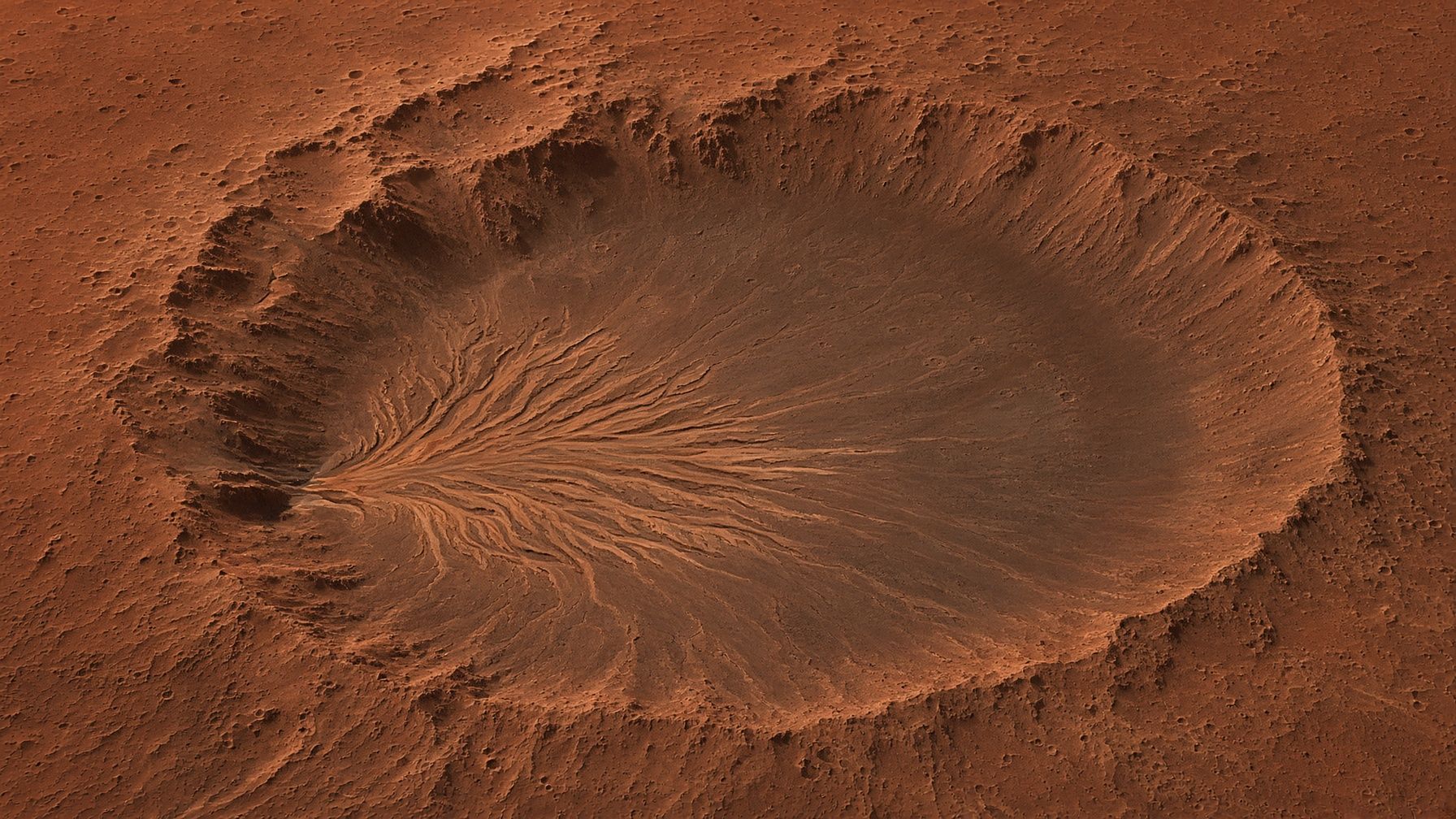
The engineering object
Mars is a precise engineering challenge, not a metaphor. Diameter 6,792 km. Surface gravity 0.38 g. A thin atmosphere, 95% CO2 at about 6 mbar. Average surface temperature −60 °C. Those four numbers set the rest of the stack: habitats must hold pressure, ISRU must work from carbon dioxide and ice, and power systems must survive dust, night, and cold.
The landmarks
Olympus Mons rises 21.9 km — more than 2.5 times Everest — and spans roughly 600 km. Immediately adjacent, Valles Marineris extends 4,000 km, a canyon system that is itself a geological archive. These are not postcards. They are the terrain any surface architecture has to plan around: landing ellipses, cable runs, ice access, and the wind regimes that move dust across half a planet.
Jezero as proof of past habitability
Perseverance observations from Jezero crater confirm ancient river deltas with preserved sedimentary deposits. Orbital spectroscopy independently supports the same wet history. That is the evidence base for in-situ resource utilization: the planet already ran a hydrologic cycle. The job now is to run an industrial one — extract ice, capture CO2, make methane and oxygen, and close the loops that turn a rover traverse into a city.
What MarsForge is for
The briefing was written for the MarsForge community on X: technical lite, first principles, no vibes. Habitat concepts, self-sustaining city roadmaps, and the subsystem list that actually matters — energy, life support, manufacturing, psychology. The live conversation stays on X. This desk keeps the public notes so the argument can be read without the scroll.
Ask this paper
Grok answers from this essay only. Sign in so the call stays on your session — one question at a time.
Sign in to askNext
The First Breath