Mars · Curiosity · Organics · Gale Crater · 12 min read · 30:32 listen
Mars’s Subsurface Sanctuary
Curiosity found the largest organic molecules yet confirmed on Mars inside a 3.7-billion-year-old lakebed. Reconstructing what radiation destroyed may matter more than what survived.
A drill hole into an ancient lake
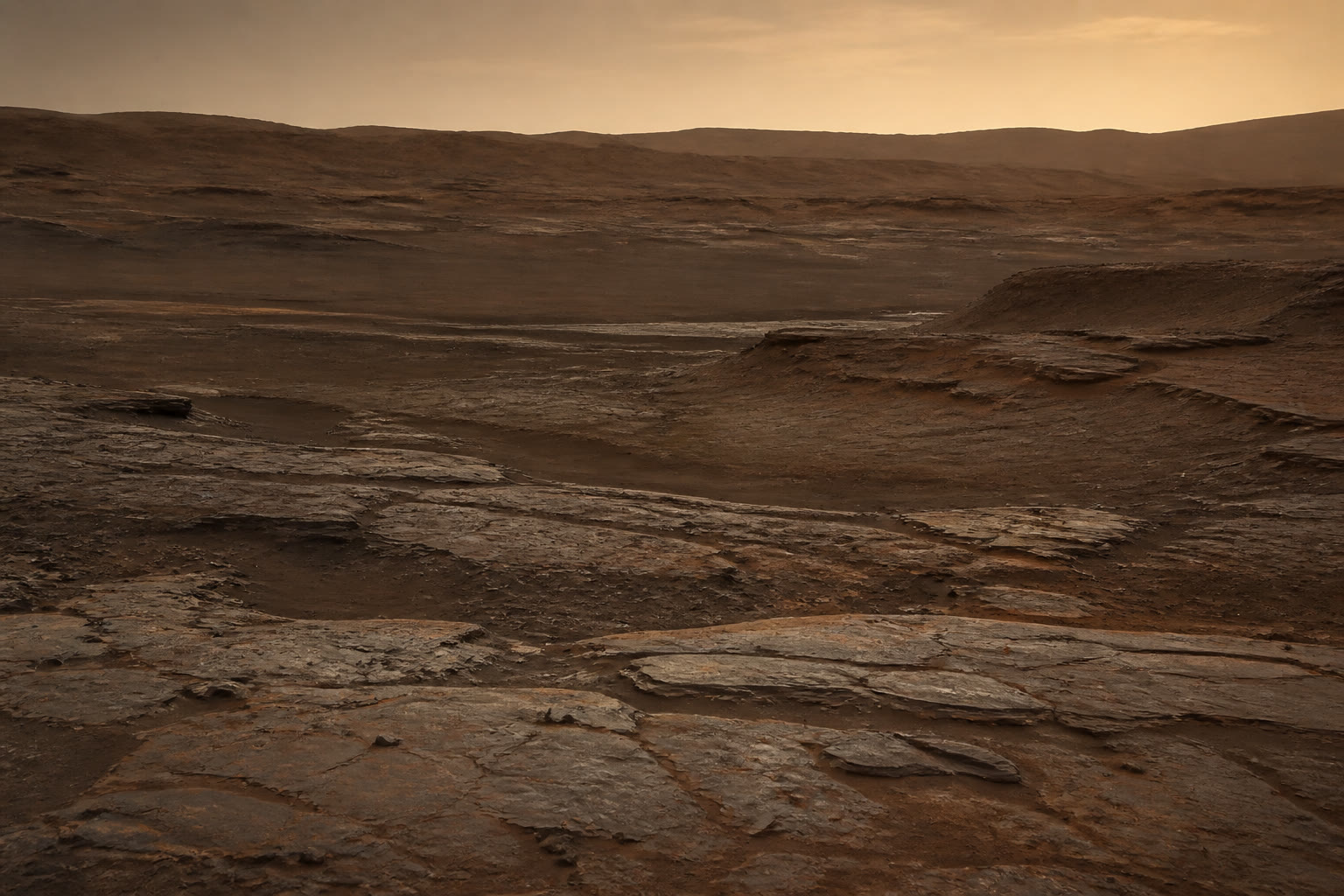
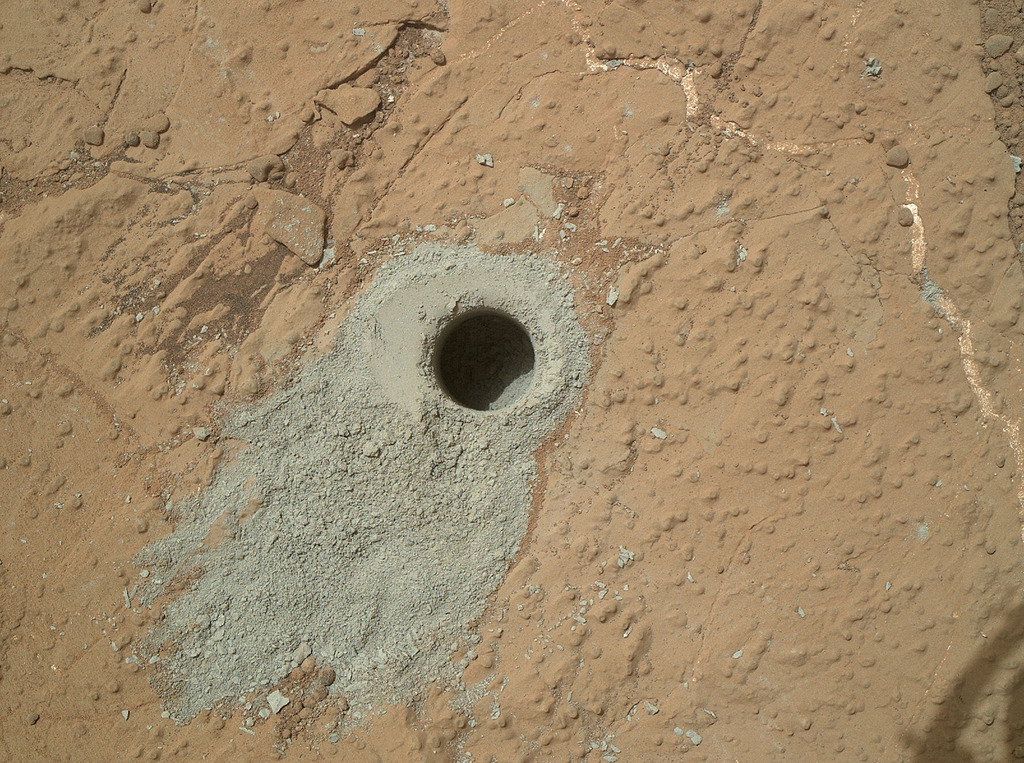
On Sol 279 — May 19, 2013 — Curiosity parked on the floor of Yellowknife Bay and put a hole in a mudstone named Cumberland. The bit went about 6.6 centimeters down and 1.6 centimeters wide. What came out was not the rust-colored dust that coats every surface in Gale Crater. It was gray powder: the freshly exposed interior of the Sheepbed member, lake mud that hardened about 3.7 billion years ago. The mission had detoured here before climbing Mount Sharp because the ground looked like a lakebed. It was. Grotzinger’s team would later write the site down as a habitable fluvio-lacustrine environment in the post-Noachian record — water that lasted, chemistry that could run, no organism required for the sentence to be true. This desk is not interested in the romance of an ancient shore. It is interested in what the lake left behind, what six and a half centimeters of rock could still hold, and what the surface radiation had already erased.
- 3.7 Gyr — age of the Sheepbed lake mud in Yellowknife Bay
- Sol 279 / May 19, 2013 — Cumberland drill
- 6.6 cm deep, 1.6 cm wide — the hole
- C10–C12 — decane, undecane, dodecane, the largest organics yet confirmed on Mars
- 27–53 ppb — measured long-chain alkanes in the powder
- ~80 Myr — modeled surface-exposure clock
- 120–7,700 ppm — reconstructed pre-exposure alkanes and/or fatty-acid precursors
- 2 m — Rosalind Franklin’s drill, late-2028 launch, Oxia Planum ~2030
What SAM actually measured
The molecules did not announce themselves on the first heat. Curiosity’s Sample Analysis at Mars instrument, SAM, is a chemistry bench in the rover’s belly: ovens, a gas chromatograph, a mass spectrometer, and wet-chemistry cups that were never meant to be used this way. Cumberland had already been a workhorse sample. Earlier SAM runs on the same powder had shown chlorinated alkanes, chlorobenzenes, and sulfur-bearing organics with structures of up to six carbons — indigenous, above background, and still small. The opportunistic derivatization was a second look at leftover material, optimized to cut the oxygen that perchlorates release when they decompose and to let residual MTBSTFA vapor do its work. First they heated the sample to about 475 °C to drive off that molecular oxygen, because it would have burned the very organics they were trying to see. Then they let the derivatization agent adsorb and heated again toward 850 °C. What came off, at tens of picomoles, were three straight-chain alkanes: decane, C10H22, at 37±7 pmol and 43±17 ppb; undecane, C11H24, at 41±8 pmol and 53±22 ppb; and dodecane, C12H26, at 19±4 pmol and 27±11 ppb. The long chains evolved in a temperature window around 320–550 °C, distinct from earlier chlorobenzene and from the hotter thiophene releases. Dodecane is the highest-mass organic molecule yet identified at the Martian surface. The compounds are indigenous to the mudstone. That is the measurement. Everything else is interpretation.
Why the instrument saw alkanes
SAM did not pull intact fatty acids out of the clay. Laboratory work on the same protocol supports a harder, narrower claim: the alkanes are consistent with decarboxylation products of C11–C13 carboxylic acids that had been preserved in the mudstone. Heat a long-chain fatty acid hard enough and the carboxyl group leaves as carbon dioxide; what remains is an alkane one carbon shorter. Undecanoic acid mixed into a Mars-like clay and run through a SAM-like oven released decane. Published heating experiments do the same mapping for the next two chains: dodecanoic acid to undecane, tridecanoic acid to dodecane. On Earth, living cells manufacture fatty acids to build membranes. Abiotic water–rock chemistry can manufacture them too, especially at hydrothermal vents, and those abiotic acids are typically shorter, often fewer than twelve carbons. The Cumberland chains sit on that line — long enough to be interesting, not long enough to settle anything. Freissinet’s team notes that still-longer acids may be present; SAM is not optimized to see them. This desk will not promote a fragment into a membrane, and it will not call a decarboxylation product an intact lipid.
How mudstone became a sanctuary
A lake is a sorting machine. Fine clay settles where the water is quiet. Grotzinger and the Curiosity team reconstructed Yellowknife Bay as a habitable fluvio-lacustrine system: neutral pH, low salinity, iron and sulfur in more than one redox state, and the biogenic elements carbon, hydrogen, oxygen, sulfur, nitrogen, and phosphorus all present. The water body had a minimum lifetime of hundreds to tens of thousands of years — long enough for chemistry to run, not a license to invent a biosphere. Those clays formed in water, and they are good at trapping organic molecules in interlayer spaces and against mineral surfaces. Sheepbed also carries sulfur, and sulfur can lock organics into tougher macromolecules. Later SAM work on other Gale mudstones made that pathway explicit: at Pahrump Hills, Eigenbrode and colleagues saw thiophenes, aromatics, and aliphatics come off only at high temperature, consistent with sulfurization protecting a macromolecular residue. The physical sequence at Cumberland is simple and unsentimental. Mud accumulated on a lake floor. It lithified. It was buried. For most of the last 3.7 billion years the molecules, whatever their origin, sat in the dark. Only much later did erosion put this particular slab back within reach of galactic cosmic rays. The sanctuary is the rock, not a habitat. Clay, grain size, sulfur, and burial are why anything at all survived the journey from a 3.7-billion-year-old lake to a 2013 drill hole. They are not a census of organisms.
The radiation clock
Mars has no global magnetic field and no thick atmosphere. The surface is a radiation environment. Once a rock is exhumed, galactic cosmic rays chew through organic bonds for as long as the rock sits in the upper few meters. Burial is the sanctuary. Exposure is the clock. Cumberland’s modeled surface-exposure age is about 80 million years. That is a blink against 3.7 billion years of burial and a long time to leave unprotected carbon in the open. In 2026, Pavlov and colleagues combined laboratory radiolysis, a destruction model, and the SAM abundances and ran the clock backward. The tens of parts per billion that SAM measured — Freissinet’s 27–53 ppb across the three chains — are a residue. The conservative reconstruction is 120–7,700 parts per million of long-chain alkanes and/or fatty-acid precursors before ionizing radiation began to work. That is a jump of roughly four orders of magnitude. The range is wide because destruction rates in a Cumberland-like matrix are still being constrained; the paper calls the estimate conservative and asks for more radiolysis work on kerogens, alkanes, and fatty acids in analog mudstones. This desk treats the reconstruction as a load, not a verdict. If the model is even roughly right, the interesting number is not what survived in the powder. It is what the radiation destroyed.
Can abiotic chemistry carry the load?
Organic is not a synonym for biological. Meteoritic infall, interplanetary dust, photochemical haze falling out of an ancient atmosphere, hydrothermal synthesis, serpentinization, and Fischer–Tropsch-type reactions can all put reduced carbon on a planet. Pavlov et al. put those evaluated sources against the reconstructed abundance and found they struggle to deliver 120–7,700 ppm of long, straight chains into a lake mudstone. That is a real constraint. It is not a proof. Unknown abiotic pathways are not fully ruled out. Radiolytic destruction rates in Cumberland-like matrices are still being measured. Two end members remain on the table, and this desk will keep both of them visible. One is allochthonous: organics synthesized in a hydrothermal system somewhere else and washed into the lake. The other is autochthonous: organics accumulated in place from a hypothetical ancient biosphere. Neither end member has been demonstrated. The evaluated abiotic list is incomplete, and the biological list is a hypothesis about concentration, not a detection of life.
- Confirmed: C10–C12 alkanes, indigenous, tens of ppb, consistent with decarboxylated C11–C13 acids in clay
- Modeled: ~80 Myr exposure; 120–7,700 ppm pre-exposure alkanes and/or fatty-acid precursors
- Strained: meteorites, dust, haze, and the named hydrothermal reactions against that reconstructed load
- Open: unknown abiotic chemistry; allochthonous hydrothermal transport; autochthonous biology
- Not established: life, a cell, a membrane, a biosignature
What would count as evidence of life
A chain of twelve carbons is a molecule. It is not a fossil and it is not a metabolism. Evidence of life would have to do work that these alkanes do not do. A strong case would need a pattern that abiotic synthesis does not easily copy: a sharp preference for even- or odd-numbered chain lengths of the kind membrane lipids leave behind, paired enantiomers that do not racemize away, isotopic offsets tied to a known enzymatic pathway, and sedimentary context that can hold those patterns in place. Textures would have to be sedimentary, not wishful. None of that is in the Cumberland chromatogram. The C11–C13 inferred acids sit on the line where abiotic hydrothermal products start to look short and biological membrane lipids start to look long, which is exactly why the detection is scientifically expensive and still not a biosignature. SAM was not built to close that case, and a rover oven that decarboxylates its own targets will not close it. Sample return could, if the right rock is cached. A deeper drill could, if it reaches material the radiation clock has barely started. Until then this desk will say the sentence in full: the largest organics yet confirmed on Mars are not evidence that Mars was alive.
Archive is not habitat
There is a second subsurface story, and it must not be glued to this one. Tarnas and colleagues showed in 2021 that radiolysis of pore water in Martian crust can, by itself, generate enough redox couple — hydrogen and sulfate — to support Earth-like chemotrophs wherever groundwater still exists. That is a habitability argument about energy in the modern deep crust. Cumberland is not that argument. Cumberland is a 3.7-billion-year-old lake archive that spent most of its life buried and the last ~80 million years being irradiated at the surface. No liquid aquifer was sampled. No living community was detected. The gray powder is a molecular tomb, not a room. This desk will not invent a glowing water table under Yellowknife Bay, and it will not staff the Sheepbed member with microbes to make the alkanes feel more important. Preservation and habitability are different loads. Mixing them is how a measurement becomes a myth.
Depth is part of the instrument
Curiosity’s bit traveled 6.6 centimeters. That was deep enough to get under the dust and into unweathered mudstone, and shallow enough that the radiation clock had already been running. The next machine that can change the measurement is built around depth. ESA’s Rosalind Franklin rover is aimed at a late-2028 launch, a landing at Oxia Planum around 2030, and a two-meter drill. Two meters is not a slogan. It is a radiation shield. The Pasteur payload is the rest of the instrument. WISDOM, a ground-penetrating radar, sees the stratigraphy before the bit goes in. Ma_MISS, an infrared spectrometer in the drill tip, reads mineralogy on the borehole wall as the hole is made. MicrOmega and the Raman spectrometer take the crushed sample apart at grain scale inside the rover’s analytical laboratory. MOMA hunts organics two ways: laser desorption, and thermal volatilization with or without derivatization, then gas chromatography and an ion-trap mass spectrometer. Oxia Planum is another ancient aqueous clay terrain at the edge of the crustal dichotomy, chosen for the same reason Yellowknife Bay was worth a detour: quiet water, clay, and a chance that the archive is still intact below the cosmic-ray skin. The lesson from Cumberland is architectural. If the molecules you care about live below that skin, then depth is not logistics. Depth is the detector.
The message in what survived
A gray powder from a 3.7-billion-year-old lake still holds C10–C12 chains. That sentence is already enough to change how this desk thinks about Mars as an archive. Clay and sulfur and burial can keep large organics through almost the entire history of the planet. The surface then spends tens of millions of years taking them apart. What SAM saw — 27 to 53 parts per billion — is the damaged remainder. The reconstruction — 120 to 7,700 parts per million — is the load the chemistry of early Mars may have to carry, by hydrothermal transport, by biology, or by a pathway nobody has named yet. NASA’s 2026 note on the Pavlov paper is careful in the same place this desk is careful: the evaluated non-biological sources do not fully account for the reconstructed abundance, and more work is required before anyone talks about the presence or absence of life. This desk will not choose among those origins for a homepage. It will keep the evidence boundary loud and the radiation clock visible. The work now is not to decorate a drill hole with a biosphere. It is to measure how fast those chains die in Cumberland-like rock, to drill below the skin, and to bring a sample home that the oven did not already interpret. The sanctuary was never the surface. It was the meters the radiation has not yet reached.
Selected primary sources
Freissinet et al., “Long-chain alkanes preserved in a Martian mudstone,” Proceedings of the National Academy of Sciences 122, e2420580122 (2025), DOI: 10.1073/pnas.2420580122. Pavlov, Freissinet, Glavin, House, Stern, McAdam, Roussel, Dworkin, Chou, Steele, Mahaffy, Buckner, and Gomez, “Does the Measured Abundance Suggest a Biological Origin for the Ancient Alkanes Preserved in a Martian Mudstone?,” Astrobiology (published online February 4, 2026), DOI: 10.1177/15311074261417879. NASA Science, “NASA’s Curiosity Rover Detects Largest Organic Molecules on Mars,” March 24, 2025. NASA Science, “NASA Study: Non-biologic Processes Don’t Fully Explain Mars Organics,” February 6, 2026. Grotzinger et al., “A Habitable Fluvio-Lacustrine Environment at Yellowknife Bay, Gale Crater, Mars,” Science 343, 1242777 (2014), DOI: 10.1126/science.1242777. Eigenbrode et al., “Organic matter preserved in 3-billion-year-old mudstones at Gale crater, Mars,” Science 360, 1096–1101 (2018), DOI: 10.1126/science.aas9185. Tarnas et al., “Earth-like Habitable Environments in the Subsurface of Mars,” Astrobiology 21, 741–756 (2021), DOI: 10.1089/ast.2020.2386. European Space Agency, ExoMars Rosalind Franklin Mission — 2 m drill, Pasteur payload (WISDOM, Ma_MISS, MicrOmega, Raman, MOMA), Oxia Planum, late-2028 launch, arrival ~2030.
Ask this paper
Grok answers from this essay only. Sign in so the call stays on your session — one question at a time.
Sign in to askNext
The First Breath